
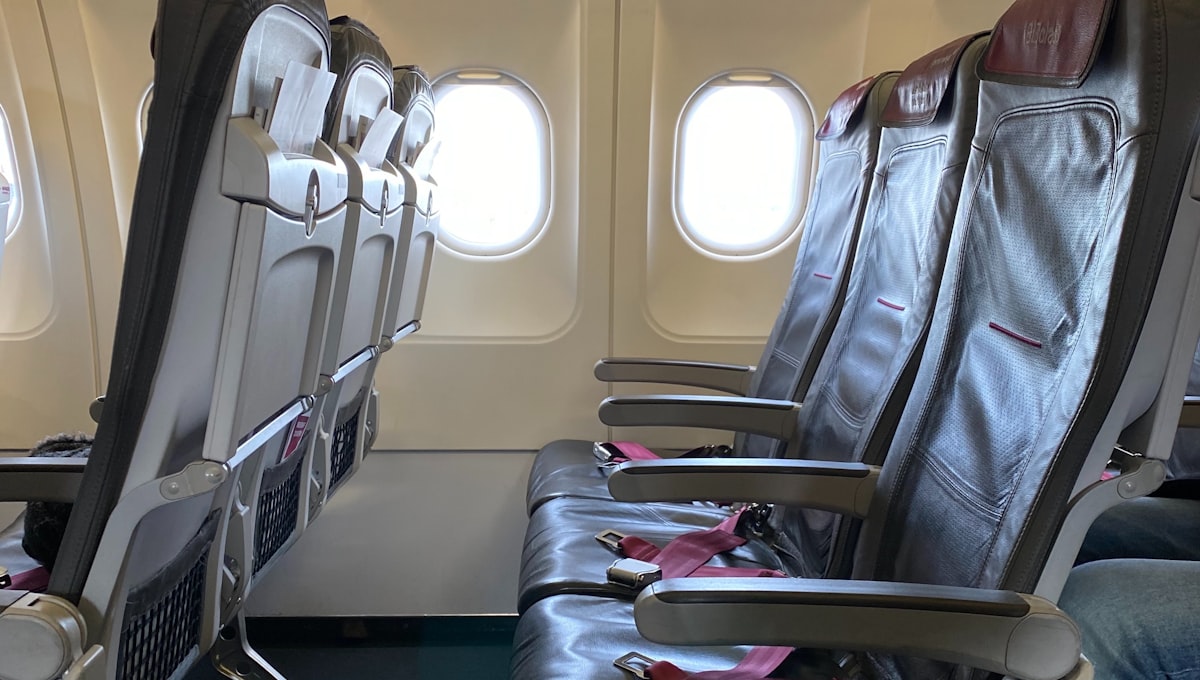
Why Business Class Is Cheaper When Booked from Other Countries
April 30, 2026
A business class seat from London to Singapore on Singapore Airlines (SQ) currently costs £4,200 return. The same seat, on the same flight, booked through the Turkish version of a major booking platform, costs the equivalent of £2,650. The cabin is Business Class. The lie-flat bed is identical. The arrival airport is Changi Terminal 3. The price difference is £1,550.
This is not a glitch, a temporary promotion, or a pricing error waiting to be corrected. It is a deliberate and long-standing consequence of how airlines and online travel agencies price premium inventory across regional markets. The gap is proportionally larger in business class than in economy, it applies to virtually every major airline, and it's been accessible to anyone who knows to look.
Why Premium Cabins Have Bigger Regional Spreads
In economy, regional pricing variation is constrained by consumer price sensitivity and competitive dynamics. Drop a fare too low in one market and airlines attract arbitrage — bargain hunters who access it through VPNs or foreign payment methods. Airlines are aware of this and moderate economy fare spreads accordingly. The typical economy variation across regional markets is 15–30%.
Business class buyers are, in the airline's internal model, assumed to be less price-sensitive. They're booking on corporate travel budgets, burning miles, or spending points. The working assumption is that premium travelers don't shop around aggressively. So airlines file wider fare buckets across different markets without worrying as much about cross-market arbitrage. The result is that the same J-class inventory on the same flight routinely carries a published fare range of 30–60% depending on the point of sale.
There are three distinct mechanisms driving this:
First, purchasing power adjustment. Airlines operating global networks file business class fares calibrated to each market's price tolerance. An SQ J fare calibrated for the Singapore corporate market might be filed at SGD 6,800 — roughly £4,000. The same fare in Turkey is filed at TRY 85,000 — roughly £2,300 — because that's the ceiling the Turkish premium market will bear. The seat costs the airline the same to operate either way. The price variation is pure revenue management.
Second, competitive pressure from regional carriers. On routes where Gulf carriers compete aggressively — EK (Emirates), EY (Etihad), or QR (Qatar Airways) — local markets near those hubs often have suppressed premium fares. LHR–DXB business class on EK is sometimes 25% cheaper when purchased through the UAE market than through the UK market, because EK is fighting for premium passengers domestically against FlyDubai and pricing to win. The competitive dynamic doesn't exist in the UK market, so the UK price is higher.
Third, market-specific promotional fare buckets. Airlines regularly run promotions in specific markets that never surface globally. KL (KLM) does this for Dutch corporate accounts around trade show season. TK (Turkish Airlines) runs aggressive J promotions for the Middle East and Southeast Asian travel corridors. AF (Air France) periodically discounts J inventory in emerging markets where it's trying to build brand presence. These fares are filed in GDS systems but often restricted by point of sale — they appear if you're searching from that market, not if you're searching from London or New York.
Routes Where the Gap Is Consistently Large

LHR–SIN (Singapore Airlines Business): UK market £3,900–£4,500 return. Turkish market equivalent £2,400–£2,800. Indian market equivalent £2,600–£3,000. The SQ Suites and Business Class product is identical across all three bookings — the Polaris-style seat, the wine list, the Krisflyer accrual rate. Only the price changes.
JFK–NRT (Japan Airlines JL / ANA NH Business): US market $6,000–$7,500 return. Japanese market equivalent $4,200–$5,100 when booked in JPY and converted at current rates. Korean market via KE (Korean Air) codeshares runs $3,800–$4,500. The JL First Class domestic lounge access at NRT is available regardless of which market you booked through.
CDG–JNB (Air France Business): French market €4,800–€5,500 return. South African market equivalent €3,100–€3,600. Polish market equivalent €3,400–€3,900. The AF La Première–adjacent Business cabin is the same aircraft regardless of purchase origin.
SYD–LHR (Qantas QF Business): Australian market AUD 9,000–12,000 return. Hong Kong market equivalent AUD 7,500–8,800 when converted. UAE market equivalent AUD 7,200–8,400. Qantas's Business Suites product on the SYD–LHR Dreamliner is the same seat; the price difference reflects what QF believes each market will pay.
These figures are based on current fare filings, not historical data. They move weekly, but the relative ordering of markets tends to be stable.
The Gulf Carriers Deserve Special Attention
EK, QR, and EY are interesting cases because they set fares for their home market (UAE, Qatar, Abu Dhabi respectively) while also aggressively courting traffic from elsewhere. Their home markets are often not the cheapest — local premium demand is high. But the markets they use to stimulate tourism and fill their connecting hubs can be very competitive.
QR business class from European cities to Doha and beyond is consistently cheaper when booked through markets in Southeast Asia, India, and select African markets. QR filed extremely competitive J fares for the Indian subcontinent on many European routes specifically to capture premium business travel between India and Europe via Doha — those fares sometimes run 35% below the equivalent published in the UK or Germany. An Indian-market QR business class fare from LHR to BLR (Bengaluru) via DOH can be meaningfully cheaper than the UK-market fare for the same routing, even though the flight departs from London.
EK's position is similarly interesting. A premium traveler in London flying to KUL (Kuala Lumpur) via DXB can sometimes find the total fare 20% cheaper by checking the UAE market even though they're buying for travel departing from London. EK has priced the UAE market to compete with SQ and QR for Southeast Asia traffic, and that competitive pricing is accessible regardless of your departure city.
How It Works Mechanically
Online travel agencies operate as resellers of GDS (Global Distribution System) inventory. When you search Skyscanner UK, results pull fares from GDS with "point of sale = GB" restrictions applied — but many J-class fares are filed as worldwide, unrestricted by point of sale. The OTA shows the price in GBP because that's your currency and location, but the underlying fare code works from any GDS terminal globally.
When you book through a market like TR (Turkey) or IN (India) via a cross-market comparison tool, you're completing a transaction with a legitimate OTA. The ticket produced is a standard IATA electronic ticket with a 13-digit number. You can check in at LHR or JFK exactly as normal. The seat, the lounge access, the miles accrual rate, the cancellation policy — none of that changes. The only thing that changed is which regional fare bucket you accessed.
The practical limitation historically was payment: some foreign-market prices required a local credit card to complete. That has become much less common with global Visa and Mastercard processing. Most OTAs now accept international cards at the regional market price displayed. Some markets (notably India) have added cardholder surcharges for international cards that partially offset the savings, which is worth factoring into the final comparison.
Positioning Yourself at a Hub
One advanced application: if you live within easy reach of a European hub, positioning yourself to book through that hub's home market sometimes yields additional savings. Flying from a regional UK airport, positioning to AMS or FRA via a budget carrier, and booking the longhaul J segment through the NL or DE market can sometimes produce a lower total than booking everything through UK channels — even factoring in the positioning flight cost.
This is worth modelling properly rather than assuming. The positioning flight (LHR–AMS, £50 return) plus NL-market J fare must beat the direct UK-market J departure from LHR with the time cost justified. It doesn't always work. But on routes where the KL or LH J fare is particularly suppressed in the home market relative to the UK price, the arithmetic can justify the additional complexity.
Using a Cross-Market Comparison
RegionFare runs this comparison automatically across 97 markets. For business class specifically, it's worth understanding which markets to prioritize. For Asian routes from Europe, IN, TR, PL, and HU are consistently worth checking. For African routes from Europe, EG (Egypt) and ZA (South Africa) frequently show competitive J fares. For transatlantic routes, BR (Brazil) and MX (Mexico) can show cheaper fares on routes that involve Latin American hubs or where airlines are competing for LATAM-connecting traffic.
The savings on a single long-haul business class return ticket can reach £800–£1,500 per person. For two travelers, that doubles. The J-class regional arbitrage is one of the few structural inefficiencies in the airline pricing system where the consumer has complete information access — the seat isn't different, the service isn't different, and the booking is completely legitimate. It's simply a matter of knowing which market to check first.
What the J-Class Experience Actually Gets You
It's worth being concrete about what regional J-class pricing unlocks, because the product itself has changed significantly over the past decade. Business class on SQ's Boeing 787-10 or A350 services is not a wider economy seat with better food. It's a fully flat 78-inch bed with direct aisle access, a door that closes for privacy, and a lounge experience at Changi Terminal 3 that functions as a day spa. On QR's Qsuite product, the seat converts into a double bed if you're traveling with a partner — this is still not replicated by any other carrier.
On a 13-hour overnight flight — LHR to SIN, CDG to JNB, JFK to NRT — the difference between economy and business class is the difference between arriving exhausted and arriving ready to function. For a business traveler, that has quantifiable economic value. For a leisure traveler, it determines whether day one of a two-week trip is a recovery day or an actual day. At the prices available through regional market comparison, the argument for upgrading is meaningfully stronger than the standard-channel prices imply.
The lounge access alone — particularly at hub airports where the airline's flagship lounge is exceptional — adds practical value. SQ's SilverKris First Class lounge at Changi is open to Business class passengers on some fare buckets. QR's Al Safwa lounge in Doha is architecturally the finest airport lounge in the world. EK's A380 onboard lounge between premium cabins is a genuinely unusual experience. These are the details that regional-market J prices make accessible to travelers who couldn't otherwise justify the standard UK or US fare.